Coastline: The food of Mediterranean Spain, France and Italy by Galletto Lucio & Dale David
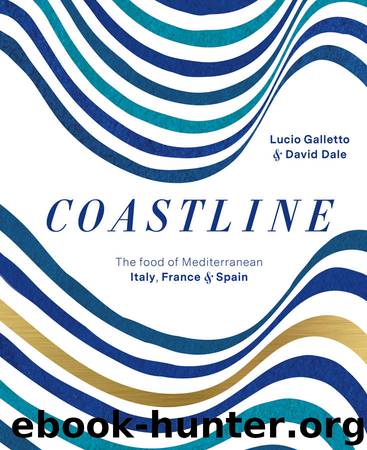
Author:Galletto, Lucio & Dale, David [Galletto, Lucio]
Language: eng
Format: epub
Publisher: Murdoch Books
Published: 2017-03-29T04:00:00+00:00
TARRAGONA (CATALUNYA): The Romans named the settlement Tarraconensis, from a Phoenician word meaning ‘citadel’. It became a resort town for the emperors, and by 200 AD the entertainment in the amphitheatre included the slaughter of Christians.
All roads lead to Tarragona
T he citizens of sunny Tarragona, just south of Barcelona, are proud their town was established by Roman invaders around 200 BC, under the name Tarraconensis. Around the amphitheatre — where a local Christian bishop named Fructuosus was martyred by the Romans in 259 AD — they have planted the fruit trees (peach, pear and apricot) and fragrant herbs that the Romans would have consumed.
The signs explain: ‘Roman agriculture was based on the Mediterranean trilogy: cereals (mainly wheat), vines and olives. From these they obtained flour and bread, grapes and wine, olives and olive oil — the basis of the Roman diet. Very aromatic plants were used to make perfumes and for various religious rituals. Thyme, for example, was burned to make holy smoke. Plums were eaten at funerary banquets. In a Roman house you would find rosemary, thyme, fennel, wormwood, ginger, marjoram and oregano, alongside vegetables and flowers such as roses, violets and hyacinths.’ No doubt they were enjoyed by the emperors Augustus and Hadrian, who treated Tarraconensis as a holiday retreat.
The city was sacked by Vandals and Huns when the Roman empire collapsed, and the Arabs occupied it for 50 years, but by the 12th century it had become a thriving Christian metropolis, allocated its own patron saint — Tecla, a 1st-century woman who was condemned to death for fighting off a nobleman trying to rape her, but who was saved from every Roman attempt at execution by a series of miracles.
Towards the end of September, the Tarragonans celebrate her life with a week-long festival, and march through the Medieval quarter carrying giant statues of roosters with breasts and firework-spouting dragons. Presumably they represent the wild beasts that failed to kill her, in another of the miracles that justified her rise to sainthood. Tecla’s arm is preserved in the gothic cathedral.
Tarragona’s other claim to fame is the quality of its paella; Catalunya’s rice fields are just to the south, producing the short-grain rice sometimes known as arros redondo or bomba . But it is also the home of Catalunya’s best fideua , made with a local form of broken-up noodles called fideus — which the Italians would know as fedellini . The local taste for rice and pasta was inspired by the Arabs, and those traditions are treated with reverence in a restaurant called Cal Joan, in the docks area at the opposite end of the beach from the Roman amphitheatre.
Within what the locals call ‘a formerly dubious tavern’, Joan Cobos and his daughter Esther have been cooking superb seafood since 1997. And because this is Roman Tarraconensis, every table is set with a bowl of the city’s signature sauce, romesco.
Download
This site does not store any files on its server. We only index and link to content provided by other sites. Please contact the content providers to delete copyright contents if any and email us, we'll remove relevant links or contents immediately.
Biscuits: A Savor the South Cookbook by Belinda Ellis(4328)
The French Women Don't Get Fat Cookbook by Mireille Guiliano(3649)
A Jewish Baker's Pastry Secrets: Recipes from a New York Baking Legend for Strudel, Stollen, Danishes, Puff Pastry, and More by George Greenstein(3585)
Better Homes and Gardens New Cookbook by Better Homes & Gardens(3576)
Ottolenghi Simple by Yotam Ottolenghi(3576)
Al Roker's Hassle-Free Holiday Cookbook by Al Roker(3519)
Trullo by Tim Siadatan(3421)
Bake with Anna Olson by Anna Olson(3391)
Hot Thai Kitchen by Pailin Chongchitnant(3369)
Panini by Carlo Middione(3323)
Nigella Bites (Nigella Collection) by Nigella Lawson(3215)
Momofuku by David Chang(3181)
Salt, Fat, Acid, Heat: Mastering the Elements of Good Cooking by Nosrat Samin(3136)
Modern French Pastry: Innovative Techniques, Tools and Design by Cheryl Wakerhauser(3121)
Classic by Mary Berry(3006)
Best of Jane Grigson by Jane Grigson(2984)
Tapas Revolution by Omar Allibhoy(2973)
Solo Food by Janneke Vreugdenhil(2962)
Ottolenghi - The Cookbook by Yotam Ottolenghi(2923)
